

The value of a developer experience is not measured by access to APIs or documentation. It is measured by how effectively a financial institution can turn an idea into action without losing time, context or control along the way.
Primacy grows when consumers and businesses rely on their financial institution for more of their financial lives. That means giving people and businesses useful ways to understand their financial position, move and manage money, make decisions, manage accounts and get the capabilities they need without leaving the banking relationship behind.
For banks and credit unions, delivering those experiences across consumer and business banking cannot depend on a fixed product roadmap alone. Expectations change. New financial needs emerge. Fintech capabilities advance. Institutions need a practical way to respond without starting over each time.
This reality makes the ability to act and adapt a strategic priority. It also makes the developer experience part of the banking experience. Before an institution can deliver something new, developers and engineers need to see what is possible, find the right building blocks, test safely, move into production and operate with clear visibility and control.
Forge Developer Experience brings together a family of connected capabilities designed to help financial institutions and their partners move from an idea to a working experience. Rather than asking developers to piece together separate tools and processes, Forge brings the resources they need into a more connected path:
What stands between a banking priority and action
A clear priority only creates value when teams know how to move it forward.
A financial institution may know exactly what it wants to improve: more relevant financial guidance, simpler business money movement, a new payment capability, easier servicing or a partner solution inside digital banking. But knowing the need is different from knowing where development should begin.
To move forward, developers need more than technical access. They need to know which resources apply, how to obtain the right credentials, where to test, what reviews are required and who owns the next decision. Without that clarity, even capable teams can hesitate to begin.
When documentation, tools, environments and reviews are disconnected, teams have to rebuild the path at every stage. The problem is not only technical complexity. It is the uncertainty created when ownership, access and next steps are unclear.
For innovation leaders, developer friction is an execution constraint. It can slow the institution’s ability to test an opportunity, act on a priority and turn an idea into something consumers or businesses can use. That is the value Forge Developer Experience is designed to deliver: a clearer, self-service path that helps development teams move from a banking need to development without having to figure out every step on their own.
Product strategy, architecture and governance remain critical. Forge Developer Experience gives teams a more direct route into execution while keeping those guardrails embedded in the development path. FI and partner developers operate as an extension of Candescent’s development ecosystem, following the same code submission workflows and built-in security and governance practices used by Candescent developers. Whether an extension is built internally, by an institution or with a partner, it follows a consistent path from development through review and ultimately toward production.
Making self-service easier to start and easier to scale
Self-service works when developers know where to begin, what comes next and where the guardrails are.
Financial institutions are taking a more active role in shaping their consumer and business banking experiences. Some ideas begin with an expert developer; others begin with a product leader, experience team or banker who sees a better way to serve an account holder. The broader Forge direction is to make that path more accessible across levels of technical expertise, and the Forge Developer Experience gives development teams the resources and guardrails to turn those ideas into working capabilities.
Not every bank or credit union has a large development organization, dedicated platform engineers or teams with time to learn another development environment from the ground up.
For many teams, self-service can create its own questions:
- Where do we start?
- Which APIs or tools apply to our use case?
- What access do we need?
- Where can we test safely?
- What happens when we are ready to move forward?
- And how do we keep the work within the institution’s security and governance requirements?
These questions matter because self-service only creates value when developers can act on it. Access to APIs, SDKs and documentation is not enough. Developers need a clear starting point, useful guidance and a path that makes the next step visible.
That is how we’ve designed Forge Developer Experience. The connected Learn, Build, Integrate & Test, Operate and Scale model brings the resources developers need into a more understandable progression. Documentation and guided resources help teams orient themselves. Templates and tooling provide practical starting points. Test environments give teams a place to validate work safely. Permissions and review processes make the guardrails clear. Operational visibility stays connected as development moves forward.
An institution may build with its own development team, bring in a partner capability through Marketplace or combine approaches. Forge Studio extends that model by giving product managers a way to use AI-powered prompting to begin turning an idea into an extension, even without development expertise. The goal is a more accessible path from idea to execution, with the flexibility to build, partner or combine the two.
Great developer tools are only the beginning
APIs and SDKs matter. The real advantage comes from keeping the path connected as work moves forward.
APIs, SDKs, documentation, code assistance and test environments are now expected. The real value comes from how well they help developers move forward. A team that is new to self-service should not have to understand the entire platform before completing a useful first action or restart every time work moves from learning to building, testing and operation.
Forge Developer Experience organizes the journey across five connected stages. Each stage answers a different developer need while keeping the next step visible.
| Stage | What developers need | How Forge supports the work |
|---|---|---|
 |
What developers needUnderstand what is available and where to begin. |
How Forge supports the work
|
 |
What developers needMove from a use case to a working starting point. |
How Forge supports the work
|
 |
What developers needValidate safely before broader implementation. |
How Forge supports the work
|
 |
What developers needMaintain visibility after launch. |
How Forge supports the work
|
 |
What developers needExpand development with consistency and control. |
How Forge supports the work
|
The value comes from continuity. Each stage helps developers complete a clear job and move into the next one without reconstructing the path. For the institution, that keeps development connected to the consumer or business banking priority that started the work.
Bringing the experience to life — Forge Design System
What teams build should feel like it belongs in their institution’s banking experience.
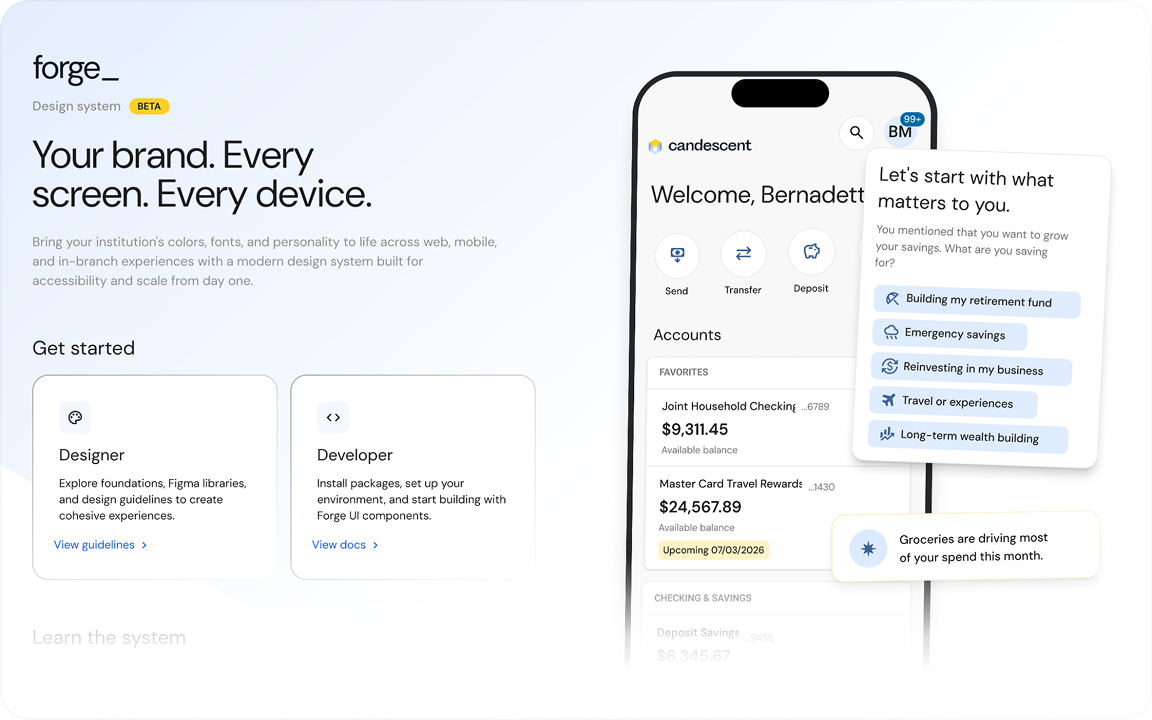
Forge Design helps carry the developer journey from what a capability does to how it comes to life in the experience. It provides the shared design foundations, components and banking patterns teams can use as they build and extend experiences across web and mobile.
Think of it as a design foundation surrounding the Intelligent Banking experience. Institutions can bring their own brand, colors, typography and personality forward, while shared components and patterns help what they build remain cohesive with the experience around it. The result is customization without creating something that looks or behaves like a one-off feature added alongside the banking application.
That matters because extensibility should create differentiation, not fragmentation. Forge Design helps institutions make the experience their own while maintaining the visual and interaction consistency that helps the overall banking experience feel like one product.
What connected self-service changes for development teams
Five shifts that make self-service easier to adopt and more useful as development expands.
For innovation and technology leaders, the goal is not simply to make more tools available. It is to reduce the uncertainty that keeps capable teams from using them.
1. Reduce unnecessary handoffs
Developers can move from discovery into defined actions more directly instead of pausing to reconstruct the process or locate the next owner. That does not eliminate collaboration. It makes collaboration more intentional by reducing dependencies created only by a fragmented path.
2. Create more predictable starting points
Documentation, code samples, templates and guided tooling help developers understand which resources apply to the use case and what a viable first step looks like. That lowers the burden on teams that are capable of building but may not yet know how to begin with Forge.
3. Build guardrails into the path
Self-service should not mean removing control. It should mean moving appropriate work closer to developers while making environments, permissions, restricted access, submission requirements and review processes clearer. Governance becomes part of the path rather than a late-stage interruption.
4. Create more capacity to act
When learning, building, testing, administration and ongoing visibility remain connected, developers can spend more time on the banking outcome and less time rebuilding the route required to deliver it.
5. Build in the tools developers already use
Agentic access extends self-service into developers’ native AI development environments. With Forge templates, MCP server, AI rules and skills, developers can use tools such as Claude, Cursor and Copilot to build customizations without leaving the workflows they already use.
Forge Developer Experience is designed to move developers from first action to governed scale
A modern developer experience should make the first step clear, the next step visible and the path to scale manageable.
Candescent designed Forge Developer Experience around practical actions developers can complete in sequence. The intent is straightforward: help developers move from understanding what is available to building something useful, then give teams the visibility and control to expand development responsibly.
This approach matters because self-service is not simply access to tools. Developers need a clear way into the platform, working patterns that reduce blank-page effort and governance that remains connected as the work advances. Forge is designed to let teams learn through action, so their first step can be useful without requiring them to understand the entire ecosystem at once.
The three actions below provide a practical way to use Forge Developer Experience. They also give innovation and technology leaders a clear way to evaluate whether the developer path is working as intended.
Together, these actions show how Forge turns self-service into a connected operating model. Developers can begin with a manageable task, build confidence through a working result and retain the controls needed as more people, applications and environments become involved.
This is where Candescent is putting a stake in the ground for the industry. A developer experience should not stop at exposing APIs or publishing documentation. It should connect the full path from first exploration through production operation and ecosystem scale, with banking context and governance built in.
Marketplace extensibility creates a shared delivery path for institutions and fintech partners
The value comes from making collaboration easier while keeping integration readiness and governance clear.
Financial institutions do not have to choose between building everything themselves and managing a disconnected collection of third-party tools. Candescent Marketplace extensibility creates a shared path where financial institutions and fintech partners can work within the same broader developer ecosystem.
For financial institutions
The same ecosystem makes it easier to discover available capabilities, understand how they fit within the banking experience and determine whether the right path is to build, integrate or use an existing Marketplace capability.
For fintech partners
Forge Developer Experience provides a consistent path to understand the Candescent platform, use common documentation and tooling, build against Candescent patterns and validate within a partner sandbox before moving to a live pilot.
Where the two come together
Partners can build, test and prepare a capability for review while FIs evaluate fit, readiness, ownership and governance. Marketplace then provides the route from a validated partner capability toward FI pilot and broader availability.
The value is not the size of the Marketplace. It is making collaboration more repeatable. Partners have a consistent way to prepare capabilities for financial institutions, while FIs have a clearer way to evaluate and adopt them without treating every integration as a one-off project.

FI teams
- Define the banking outcome
- Explore available capabilities
- Evaluate fit, readiness and ownership
- Choose whether to build or integrate

A shared Forge path
- Common documentation and tooling
- Design and integration patterns
- Sandbox validation before a live pilot
- Governed review and operational visibility

Fintech partners
- Understand the Candescent platform
- Build and test in a partner sandbox
- Prepare the capability for review and pilot
- Extend through Marketplace when ready
The next banking experience starts with a connected developer path
Developer experience gives strategy a more workable route into execution.
Banks and credit unions strengthen primacy by becoming more useful as the needs of consumers and businesses evolve. That requires the ability to translate priorities across consumer and business banking into relevant experiences, whether the right path is to build, integrate or extend what already exists.
Forge Developer Experience supports that adaptability by connecting the work developers need to do from learning through scale. Candescent is defining the developer experience around the full job, not only access to APIs, SDKs or documentation. The value is the continuity from banking intent through development, testing, operation and growth, with clearer guardrails along the way.
Innovation leaders should treat developer experience as part of the institution’s ability to execute and differentiate. The immediate opportunity is to help capable teams take a useful first step, understand the next one and build confidence without losing the banking outcome or the institution’s guardrails. That is the standard Forge Developer Experience is designed to set.
Your next differentiated banking experience may begin with a strategic priority. Bringing it to life begins with a connected developer path.
Explore Forge Developer Console
Visit the Developer Console to access the tools, documentation and resources you need to start building with Forge Developer Experience.
New to Candescent?
Contact us to explore how the Candescent Intelligent Banking platform, powered by capabilities like Forge Developer Experience, can help your institution turn banking priorities into differentiated experiences.
Ready to put Forge Developer Experience to work?
Whether your development team is ready to move to Forge Developer Experience or is exploring self-service for the first time, contact your Candescent representative to get access and identify the right place to start.

