
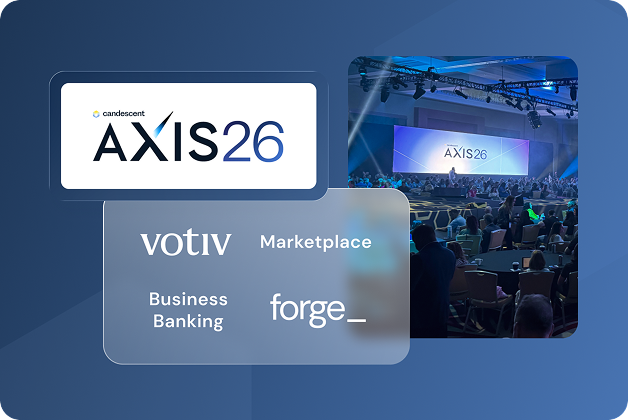
In our annual report, we wrote that the era of intelligence had arrived. At AXIS 2026, we showed how Candescent is leading it.
Votiv. Forge. Marketplace. Business Banking as an operating platform.
Four announcements, each one helping answer the same question: if digital parity is mostly here, how do financial institutions differentiate now?
Not from adding more features, but from connecting data, design, and real-time intelligence so banks and credit unions can recognize what matters, respond with relevance, and guide relationships more effectively.
If that sounds like a technology story, there is more to understand fully.
This is really a leadership story.
Because customers and members do not experience banking as a set of internal systems. They experience it as a series of moments. A payment that clears with confidence. A bank app that knows what matters now. A recommendation that feels useful instead of opportunistic. A problem resolved without friction. A banker who has context before the conversation begins.
The institutions that lead in the next era will be the ones that make those moments feel more connected, more intelligent, and more human.
That is why we believe Intelligent Banking ladders up to four defining outcomes: experience, growth, trust, and primacy. Not as a framework, but as a standard.
Experience is where intelligence either becomes real or disappears into complexity.
Good design in banking is often mistaken for polish. In reality, it is about cognitive load, helping a person move from uncertainty to action, making the right next step obvious.
Most banking apps are still digital filing cabinets. They store your data and wait for you to do the heavy lifting. Votiv is built on the opposite premise. It surfaces what matters, anticipates what comes next, and guides customers and members toward better decisions without making them guess. And it does that across every interaction because every reset is a trust deficit. Every handoff that loses context signals that the institution does not actually know the customer or member.
Growth follows from relevance, not reach.
Not from sending more messages, but from being useful at the right time. When institutions connect signals across onboarding, engagement, servicing, and advice, they can act in moments where the user is already paying attention. The growth engine becomes less dependent on interruption and more dependent on relevance.
This is also where differentiation is won. Not solely in the ambition to deliver Intelligent Banking, but in the ability to execute it. Institutions that operationalize intelligence into consistent, real-time relevance will pull ahead. Those that do not will remain interchangeable.
But relevance requires a platform that can move fast enough to act on what it knows. We watched development teams spend months just getting to an MVP. That is not a developer problem. That is a platform problem. Forge exists because Intelligent Banking has to be buildable, not just describable. And an ecosystem that extends the platform without fragmenting it is how institutions solve more of their user needs without sending value elsewhere. That is what Marketplace is for.
Trust is the operating system beneath all of it.
We are entering an era in which more banking interactions will be shaped by AI, decisioning, and increasingly connected ecosystems. That creates enormous upside, but it also raises the bar.
Trust is not brand language. It is the permission customers and members give you to use their data to make their lives easier. Build it into the architecture, into model governance, authentication, privacy, and third-party oversight, and innovation scales. Leave it as a marketing claim and it becomes the ceiling on everything else.
Marketplace is built around pre-vetted, actively maintained partners—and just as importantly, the solutions they deliver and seamlessly integrate into the Candescent platform—because trust cannot be an afterthought in an ecosystem model. The institutions that scale Intelligent Banking responsibly will be the ones that build governance into the architecture from the beginning, not bolt it on after the fact.
And then there is primacy. The strategic prize, the outcome that makes all the others worth pursuing.
Primacy is not simply being one of the places where someone has an account. It is being the institution they rely on first, the one that feels most useful, most dependable, and most connected to how they manage their financial life.
The average checking account holder now maintains three deposit accounts at different institutions. One in five moved money away from their primary bank in the last three months. That gap is widening.
Business banking is one place where that fragmentation is particularly visible. Too often, institutions are working across disconnected tools rather than a connected operating layer. The businesses our clients serve are not waiting. They are operating in real time, and their bank needs to as well.
Connecting onboarding, payments, servicing, and reporting into a single operating layer is not a feature upgrade. It is a different model entirely.
Across all four outcomes, there is a deeper dynamic worth naming: Intelligent Banking gets stronger as it is used. The more customers, members, bankers, and institutions use a connected platform, the more context it can bring to each interaction. Signals compound. Relevance improves. The next experience becomes more useful than the last.
The gap between institutions that will lead this era and those that will not is not about ambition. Everyone wants to deliver Intelligent Banking. The difference is execution—and not only does every institution need to get this right, but they must also do so to meaningfully differentiate.
AXIS was about building the foundation that makes it possible.
That is the standard to which Intelligent Banking should be held.
If you want to go deeper on what Intelligent Banking requires, we put it all in one place.
Download the Intelligent Banking booklet here.